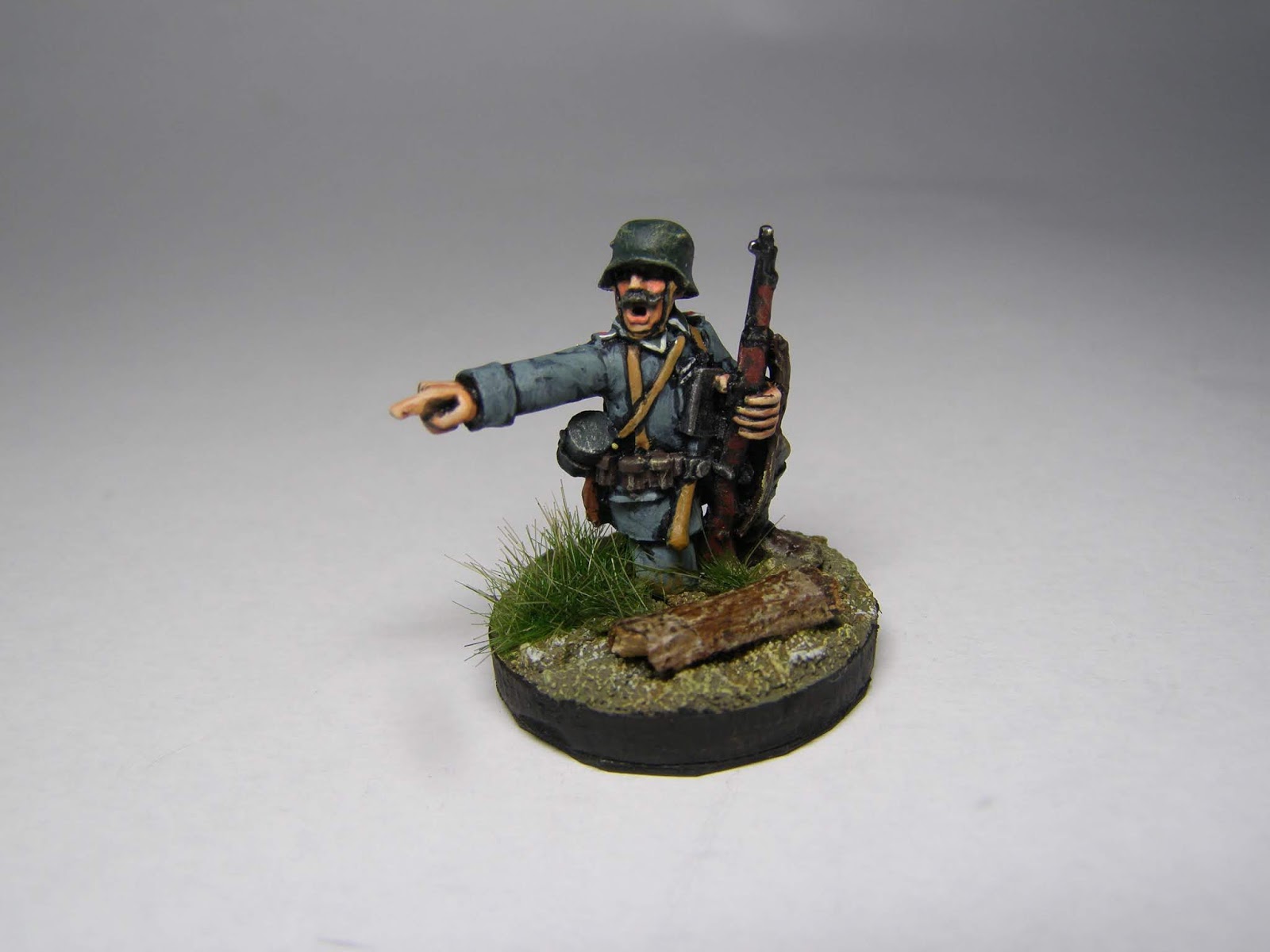
Here we have something a little different to the bright colourful uniforms that I usually like to paint. I have long been fascinated by the appearance of the British Tommy of World War One. The outline and silhouette of the uniform is unmistakable and even when portrayed as a shadow on memorials the appearance is, by now, iconic.
I had no intention of really buying 28mm figures. I had some Airfix 1/72 scale plastic figures in the attic and indeed still have them. It was at a wargaming show at Donnington in around 2015 that I saw the Great War Miniatures for the first time. I was bowled over by what I saw. The detail and poses were just how I would want them to be. So I bought some....
...and then the research began. How do I organise the units? which rules do I use? Surely it's just trenches and artillery fire and maybe some breakthroughs.? Well I soon learned about the history and the more I learned, the more interest I gained.
My knowledge is much greater now than when I started. I really had no idea just how developed the infantry tactics became by 1918. The improvements in low level infantry operations where incredibly rapid and by the time of the great allied offensive, these tactics can appear very modern indeed.
I bought the 'Amiens 1918' campaign book from Osprey and read much further. I decided that this was likely to be the period I would aim to paint for, so it didn't have to be all mud on the bases. I could also use the figures for the German Kaiserschlacht offensive and again play a war of movement (albeit in the opposite direction!).
I don't tend to play skirmish games but I do like the Chain of Command rules from Too Fat Lardies. I had initially bought their 'Through the Mud and the Blood' rules but struggled with the card concept. I discovered that the Lardies had written a modification for Chain of Command in one of their published 'Specials'.
So it became army painting time. I got so far with it then stopped as other interests came my way. This always happens and I have learned to just go with the enthusiasm in which ever way it takes me. I always tend to come back to a project....and so I have. I have now finally finished a British Platoon.
The platoon consists of four parts. The Rifle Section, The Bomber Section, The Rifle-Bomber Section and the Lewis Gun section ('Through the Mud and the Blood' was immensely helpful in explaining this clearly). I have also painted a company commander (Major), and Adjutant (Captain), the Platoon Commander (Lieutenant) and Platoon Sergeant. These four figures all play an important part in the Chain of Command rules.
As readers of my (infrequent) blog might recall, I do like rules which feature Command and Control as a major part of the key components of the game.
I also painted up a Vickers Machine Gun team as a support element. My plan is to continue and paint up a Tank or three - maybe a 'Whippet' as well as the classic MkIV male and females and an 18pdr. I'm not sure about a Stokes mortar as that appears to have been a trench weapon rather than used to support attacks in the open. That would be a job for rifle-bombers, though some references of the Stokes mortar being used in such a way would be very welcome.

I was surprised at how much work has to be done to paint a unit in khaki well. I always appear to fall in to the trap of thinking that it will be a quick task, but the shading necessary to make things work and fit in with the many examples of clothing and equipment which we see (or own) means that one really works hard to obtain the right look. In addition I think that there might have been a subconscious element at play in trying to make a good effort to represent the uniforms that my relatives would have worn back in those days (Ox & Bucks Light Infantry and Machine Gun Corps being the two units that I know they served in for certain).
The research element also took a long time. I wanted to paint up the unit as a British unit at Amiens, who were preferably a conventional county line infantry Battalion. I had to read up on the multitude of divisional and brigade symbols and how, where and when they were worn.
I decided to paint the unit as being a platoon from 5 Royal Berkshires. This then has a relatively local connection and were part of the 36th Brigade, 12th Division, British 4th Army.
I also liked the simplicity of the Divisional badge of the Ace of Spades. These were painted on to the rear of the helmets and also stitched on to the back of tunics beneath the collar. More than once I wished I was using decals for these, instead of hand-painting them on! It was harder than I thought!
The figures were a joy to paint (despite the aforementioned tricky bits), and they all exude bags of character.
I used a mixture of different paints and started with a black undercoat. Thankfully I have a folder where I keep one piece of paper for each unit type that I paint. Listed by numbers are the steps I take and the paints used. So when I did go back to them I could continue to paint the men and they all maintained a similar uniformed appearance.
I mostly used Vallejo and Foundry paints though I did use Flames of War's 'British Battledress' for the main uniform khaki. I have something like 36 steps to painting a unit like this. On the rear of the base is a simple colour indicator to show which section the men are in.
This is rather photo-heavy and I would probably have been better off publishing pics by section. When I paint the Germans that is probably what I will do! I'll just let you scroll through the last pics until the bottom.
Next photos will be the Rifle-Bombers, Lewis teams and Vickers Machine gun. It has been really nice to get a whole platoon finished. It has been one of those years where projects have been started and not quite completed.
I have also been very slow taking photos of units and then taking up table space with new projects before I have taken snaps. I have painted a lot more in 2019 including; Late Romans in 28mm, Zulus and Natal Native Contingent, 10mm Romans, 15mm American Civil War Generals, 28mm English Civil War dragoons, 28mm Ancient Greeks and Jacobite Wars British Infantry in 10mm. I will endeavour to get photos of these all up in due course!
Best wishes for 2020!